


True Justice & Loving Kindness for Young Men Whose Color is of the Earth


During this season, when we have just celebrated Christmas and Hanukkah, and honored the continuation days of Thich Nhat Hanh and Martin Luther King, Jr., I would like to recognize and honor the children who have done nothing to deserve the dehumanizing treatment they continue to endure.
Under the new regime, my recurring nightmare has been imagining children whose deepest fears come true when they return home to find a parent deported. One of my most direct encounters with this suffering came through a man supported by CASA, an organization that provides critical services and advocates for the rights of immigrant and working-class families. His lawyer wept as she described how his wife was suddenly left to raise their two young children alone.
Whenever I reflect on that mother’s pain, I remember a former principal at the high school where I worked as Dean of Students, who once asked me, “Do Latinx parents care about their children?” This same principal later demoted me when she discovered that I had been writing letters to a student in jail—a young man who had committed a terrible offense. She was outraged that I had chosen not to abandon him. Today, that young man is thirty-two, the same age as my younger child. Recently he sent me a letter filled with gratitude and insight.
The principal had once insisted he would amount to nothing, yet his reflection and humility remain among the most meaningful fruits of my career. I should have reported her for the harm she caused to some students. I still remember how she demeaned a young Latina girl until the child burst into tears.
When Trump won the first time, another principal reduced the support of a lawyer who had been prepared to speak to students whose parents were at risk of deportation during an in-school program I organized for immigrant students. He rescheduled the lawyer’s visit to a time when many of the children could not attend because they were working or caring for younger siblings. He preferred to please powerful parents who were unconcerned about “other people’s” children. The lawyer was meant to inform them about their rights and how to seek help. After the principal acted, he could not look me in the eye. He had chosen politics over his pledge to serve every child.
My relationship with the incarcerated student led me to devote more than a decade of my life to restorative justice and supporting and advocating for children caught in the school-to-prison pipeline.
One day, I saw a group of African American boys dropping trash on the ground at a metro station. Instinctively, I looked at them as a Dean of Students preparing to correct misbehavior. But they stared back—directly, defiantly—and continued. In that moment, I understood: they were expressing with their bodies how little the system cared for them. We know what redlining and territorial injustice have done to children whose skin resembles the color of the earth.
This reality reminds me of the American myth of Manifest Destiny, introduced in 1845 by journalist John Louis O’Sullivan. It became a doctrine of providential expansion used to justify violent acts—including the Mexican-American War of 1846–48. With the Treaty of Guadalupe Hidalgo, Mexico lost 55% of its land. Mexicans living in the ceded territories lost their rights as landowners; Mexican-American children were racialized as second-class citizens and barred from attending school with white children. Generational academic underperformance followed naturally—even painfully.
Even the most well-intentioned principals and teachers struggle to undo the damage caused by social and territorial injustice. For the Children: Lessons From a Visionary Principal depicts everything Principal Madeline Cartwright did for low-income children at Blaine Elementary in Philadelphia. Yet every afternoon, those children returned to slums—territories society had abandoned.
One of the most unforgettable episodes of Dr. Quinn, Medicine Woman, “Separate But Equal,” deepened my understanding of African American education after slavery. Anthony, the adopted son of formerly enslaved parents, seeks a better education than the new Freedmen’s school can offer. His desire to attend the white school provokes outrage; the teacher claims his presence would be “disruptive.” Dr. Quinn gently challenges him: “Aren’t you a teacher?” Her son Brian refuses to attend the segregated school and writes an editorial. The children’s acts of nonviolent resistance set the entire town on a path toward moral awakening. The series also portrays the unrelenting displacement and mistreatment of Native families—adults and children alike.
Wilma King’s African American Childhoods further illuminates the courage of Black children during desegregation. My favorite story is that of Melba Pattillo, who survived hatred and violence in her high school by reading a book on Gandhi given to her by her grandmother. She used nonviolent “mind games,” as she called them, to rise above each assault.
Throughout the Civil Rights Movement, children demonstrated extraordinary bravery. Members of the Emmett Till generation were suspended, expelled, and incarcerated for their activism. The Birmingham Children’s Crusade is perhaps the clearest example: after eight days of protest in May 1963, the city agreed to desegregate and release all imprisoned protesters. It was the disciplined, courageous nonviolence of children that pushed the movement forward.
The Beauty of All Children: Being With Children, Being Like Children
“And I am the pirate, my heart not yet capable of seeing and loving.”—Call Me By My True Names, p. 17–18
One of my most beautiful memories at Từ Hiếu, where Thầy’s ashes rest, is of three young girls playing with cairns near his hut. I smiled, imagining how much Thầy would have loved seeing them in that sacred space. He placed immense value on children and understood the importance of nourishing them.
In his small living quarters at the museum near Từ Hiếu, there is a photo of Thầy offering a handful of leaves to a young girl. I can almost hear the Dharma teaching he was giving her. Sister Định Nghiêm told us that Thầy believed children should learn profound insights—like no-birth and no-death—in simple, accessible, nourishing ways.
Thầy had a naturally tender way of being with children. Early in Fragrant Palm Leaves, seeking silence, he retreats into the forest—only to encounter a group of boy campers. He ends up spending much of his time with them. When one insists he has seen a ghost, Thầy replies, “I do believe you—but only a little,” and the boys laugh. Soon he is teaching them about Buddhism.
Thầy held a deep reverence for children, seeing them as embodiments of mindfulness, purity, and interconnectedness. He often spoke of children as teachers of presence, noting their natural ability to live in the moment and to perceive the world with fresh, uncluttered eyes. In his teachings, he urged adults to safeguard and nurture children’s innate joy, compassion, and mindfulness.
Throughout his writing, Thầy honors the boundless beauty and innocence of children—from the children of war-torn Vietnam to Svasti, the buffalo boy in Old Paths, White Clouds—along with the unconditional love that they both deserve and require for their wholesome growth. In Fragrant Palm Leaves, he writes about the children affected by war:
The streets are filled with pale and thin children. I don't know why, but I find these children beautiful, even the poorest among them. They don’t have the rosy cheeks and robust health of children from well-off families, but they are beautiful in their own way. I think all children are naturally beautiful. But perhaps I’ve paid more attention to these children in recent months, and so I am able to appreciate deeply their beauty. (p. 162-3)
Pebbles in Children’s Pockets
Perhaps Thầy was influenced by the way the Buddha treated Svasti, an untouchable boy. In a story that opens Old Path, White Clouds, the Buddha uses Svasti’s explanation of how to care for a water buffalo—one of the humblest roles in that society—to teach the Path to his disciples. It was radical for the Buddha to impart a lesson using the words of a child, especially one of low caste. In traditional caste-based societies, children’s voices were rarely encouraged or respected. The Buddha later invited Svasti to join his Sangha when he was old enough and free from caring for his siblings.
Perhaps Thầy was also shaped by the love of his teacher at Từ Hiếu, who treated him with tenderness and respect—most touchingly when he spent an entire night mending Thầy’s robe. Recognizing his young student’s gifts, the teacher sent him to study at the prestigious Bảo Quốc Buddhist Institute. If his teacher had been harsh or dismissive, would Thầy have become the person we know today?
In honor of Vietnamese Mother’s Day, Thầy wrote A Rose for Your Pocket, one of his most moving essays—a reflection on the transformative power of a mother’s love and the mindfulness required to recognize and honor it. Raised by a loving mother and nurtured in a monastery that respected the parent-child bond, Thầy was well-rooted and prepared to extend his compassion to the world. Yet he always understood that a child who is not loved can become hardened, recognizing the crucial role of love in shaping one’s path.
I saw Brother Pháp Lưu at an Earth Retreat, teaching children how to meditate with pebbles. It reminded me of A Pebble for Your Pocket, which Thầy wrote specifically for children, offering simple, nourishing practices to cultivate inner peace. Brother Pháp Lưu engaged the children with such warmth—asking them questions, truly listening, and welcoming their wonderfully outspoken responses.
Across the world, more schools are beginning to teach meditation to children in place of punitive measures, helping to interrupt the school-to-prison pipeline. Perhaps every child should be encouraged to carry a few stones in their pockets—symbols of steadiness, presence, and peace. If we cultivated mindfulness instead of punishment, imagine how much suffering could be prevented, and how many resources now spent on detention centers and prisons could be redirected toward healing and growth.
Engaged Mindfulness & Sanctuaries for Children
Our Engaged Mindfulness group dedicates much of our practice to supporting children—especially those whose mothers have been impacted by incarceration, domestic violence, poverty, or homelessness. We are deeply grateful to all who recently donated gifts for the fifteen children and their mothers and grandmothers supported by Community Family Life Services. We remain committed to supporting about ten families each year—including caregivers—by offering school supplies, books, back-to-school resources, and contributions to Christmas celebrations.
In my illustration, I paint the sun and the moon offering equal light to boys of all backgrounds, surrounded by male figures who inspire, protect, and speak encouraging words to them—especially to those most affected by the school-to-prison pipeline—while giving them precious gifts. Jesus Christ stands among them, asking ICE agents to stop harming children.
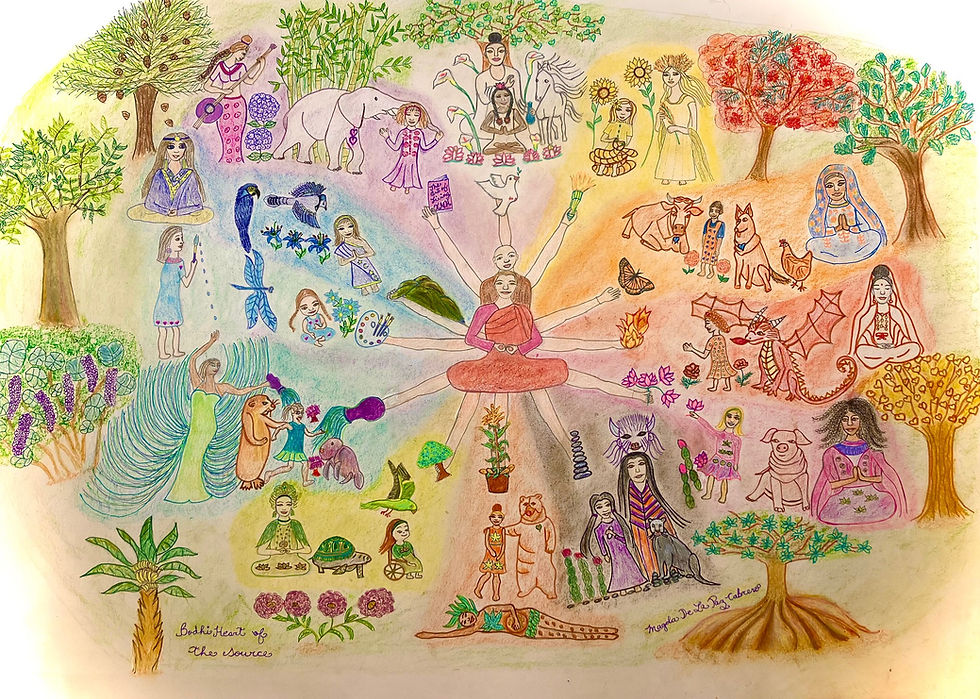
In another illustration, I depict a sanctuary for children—a metaphorical garden of territorial justice, a place where every child is healthy, cherished, and free to thrive. This garden embodies the visions of my teachers: Dr. King’s Beloved Community and Thầy’s insight of Interbeing.
In one last illustration, In another illustration, I drew the son of an incarcerated mother. She stands behind bars. The boy embraces Thầy, and Thầy places his hand gently on the child’s head—a gesture of protection and a vow to see him grow into a man of integrity.
I see Engaged Mindfulness as a protective and transformative force for children—not only in this country, but everywhere. A village of peaceful resistance built on true love and true justice.
May our practice continue to open pathways toward a world in which every child is nurtured, protected, and allowed to bloom.
Questions for Reflection
How can I contribute to the well-being of the children in my family, my community, and my society?
How can my sangha work together to meet the needs of underprivileged or unseen children?
How can I remember, cultivate, and embody the innate qualities of children to deepen my own Mindfulness?
Do I have a deep understanding of the need to nurture and care for children? How can I strengthen it?
What do I do—or long to do—to support the well-being of children around me and in society as a whole?
Comments